
Free shipping on orders over €75
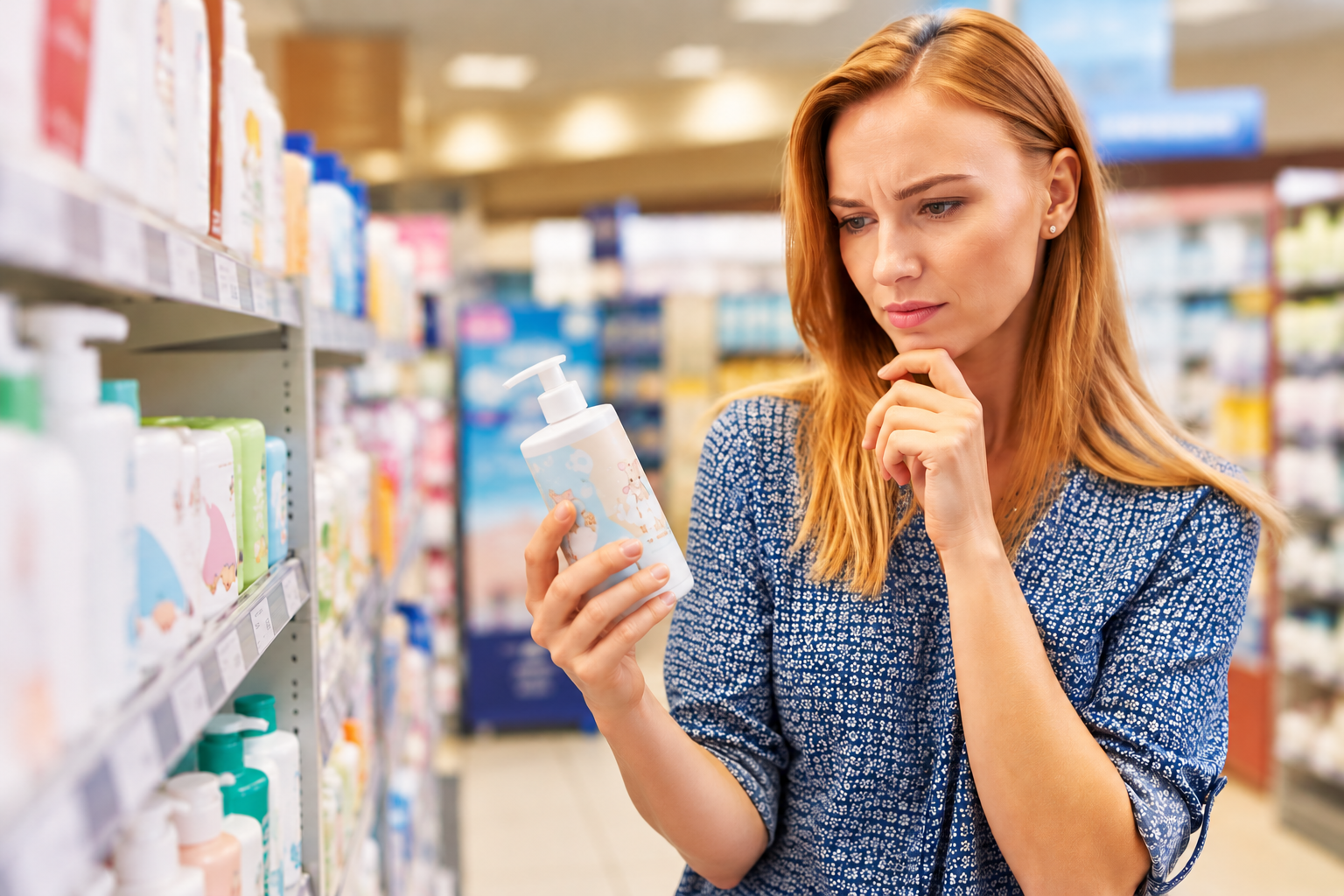
When choosing skincare for your child, words like natural, gentle, clean and made for kids can feel reassuring.
But they don’t always tell you everything you need to know.
The ingredient list on the back of the bottle can give you much more useful information about what you are actually putting on your little one’s skin.
And no, you don’t need to become a cosmetic chemist or understand every complicated ingredient name.
You just need to know what to look for.
Here are some ingredients and categories worth paying attention to when choosing cosmetics for babies and children.
A child’s skincare routine usually doesn’t need to be complicated.
For many families, the goal is simply to keep it gentle: cleanse when necessary, moisturise when needed and avoid unnecessary irritation.
This becomes especially important when a child already has sensitive or eczema-prone skin. Dermatologists recommend paying particular attention to potential triggers and choosing gentle products appropriate for the child.
That’s also why reading the ingredient list – rather than relying only on claims on the front of the packaging – can be such a useful habit.
Fragrance makes lotions, shampoos and bath products smell lovely, but it doesn’t necessarily add anything to their skincare function.
On an ingredient list, fragrance may appear as:
or as individually named fragrance ingredients.
Some fragrance ingredients can cause allergic contact dermatitis in people who are sensitised to them. European cosmetic rules therefore require certain fragrance allergens to be individually declared when they exceed specified concentrations.
This doesn’t mean that every fragranced cosmetic is unsafe.
It does mean that fragrance is something worth considering – particularly if your little one has sensitive or eczema-prone skin.
The American Academy of Dermatology, for example, recommends choosing fragrance-free products for children with eczema.
And there is an important difference between fragrance-free and unscented: an unscented product can still contain ingredients used to mask other smells.
What to look for:
If sensitivity is a concern, look for products specifically labelled fragrance-free and check the ingredient list rather than relying on smell alone.
“Fragrance” isn’t just one ingredient.
A fragrance composition can contain different substances, and some fragrance allergens must be individually listed on cosmetic labels in the EU when present above established thresholds.
So you might see individual fragrance-related names appearing alongside parfum on a label.
That doesn’t automatically mean the product is dangerous.
In fact, the purpose of this labelling is to help consumers – particularly people who already know they are sensitised to a specific fragrance allergen – recognise it and make an informed choice.
What to look for:
If your child has a known allergy or sensitivity, checking the complete ingredient list can help you identify ingredients your healthcare professional has advised you to avoid.
You may have seen “paraben-free” written on cosmetic packaging.
But parabens are a good example of why ingredient conversations need a little nuance.
“Parabens” describe a group of preservatives; they shouldn’t all automatically be treated as if they were the same ingredient with the same safety profile.
For example, the EU Scientific Committee on Consumer Safety evaluates individual parabens and their permitted concentrations separately.
Recent European assessments have specifically considered children’s exposure to butylparaben, including aggregate exposure from multiple cosmetic products.
So rather than simply assuming that all parabens are bad, it is more useful to understand which particular preservative a product contains and how it is being used.
What to look for:
Read the complete INCI list and, when you have questions about a particular ingredient, look for information about that specific substance rather than the broader ingredient family.
Salicylic acid is another example of an ingredient where age, concentration and type of product matter.
In the European Union, its use in cosmetics is regulated, and specific restrictions apply to products intended for young children.
The EU Scientific Committee on Consumer Safety has also specifically assessed children’s exposure to salicylic acid.
This is why blanket statements such as “this ingredient is toxic” or “this ingredient is completely safe” aren’t particularly helpful.
Context matters.
What to look for:
Choose products formulated for your child’s age and follow the manufacturer’s instructions. If you’re unsure whether an active ingredient is suitable for your child, ask a qualified healthcare professional.
You may also have heard that parents should avoid “sulfates”.
This is another area where broad labels can be misleading.
Sulfates are a category of ingredients rather than one single substance, and different cleansing ingredients can behave differently depending on the formulation and concentration.
Instead of trying to memorise a blacklist, think about the product as a whole.
For children with particularly sensitive or eczema-prone skin, dermatologists generally recommend mild, fragrance-free cleansers rather than harsh cleansing routines.
The goal isn’t to become afraid of long chemical names.
It’s to choose products thoughtfully.
Not necessarily.
Something being naturally derived does not automatically make it suitable for every child’s skin, just as a synthetic ingredient isn’t automatically harmful.
Natural ingredients can also contain allergens or cause reactions in people who are sensitive to them.
So when choosing children’s skincare, try to look beyond a single word on the front of the packaging.
Ask:
What is actually in the product?
Why is it there?
Is the product appropriate for my child’s age?
Does my child have any known sensitivities?
Those questions tell you much more than a green leaf on a label ever could.
You don’t need to understand every ingredient at first glance.
Start with a few simple habits:
1. Turn the bottle around.
Don’t make your decision based only on front-of-pack claims.
2. Read the full ingredient list.
Look for ingredients you already know your child reacts to.
3. Pay attention to fragrance.
Especially when choosing products for sensitive or eczema-prone skin.
4. Choose age-appropriate products.
A product being safe for adults doesn’t automatically make it the right choice for a baby or young child.
5. Keep the routine simple.
More products don’t necessarily mean better care.
6. When in doubt, ask.
If your child has eczema, allergies, persistent irritation or another skin condition, speak with your paediatrician, pharmacist or dermatologist about the products you’re using.
At Apoëna Kids, we don’t believe parents should have to feel frightened by an ingredient list.
We believe they should feel empowered to understand it.
That means asking questions, looking beyond marketing claims and making thoughtful choices based on what works for your family.
Because conscious care isn’t about trying to create a perfectly “chemical-free” world.
Everything around us is made of chemicals.
It’s about becoming a little more curious about the products that become part of our children’s everyday routines.
Read the label. Ask questions. Choose with intention.
That small habit can make choosing your little one’s skincare feel a whole lot simpler.
This article is intended for general educational purposes and does not replace individual medical advice. If your child has eczema, allergies, persistent irritation or another skin condition, consult an appropriate healthcare professional.